
Research Areas
McGill FMER researchers contribute to the advancement of knowledge across all levels of medical education, including undergraduate education, postgraduate training, and the continuing professional development of family medicine clinicians and scholars.
Drawing on the expertise of its members, the FMER scientific programme is organized around four interconnected research areas. Each area is led by an FMER researcher with relevant expertise, while Knowledge Synthesis also serves as a transversal area that informs and strengthens research across the programme.
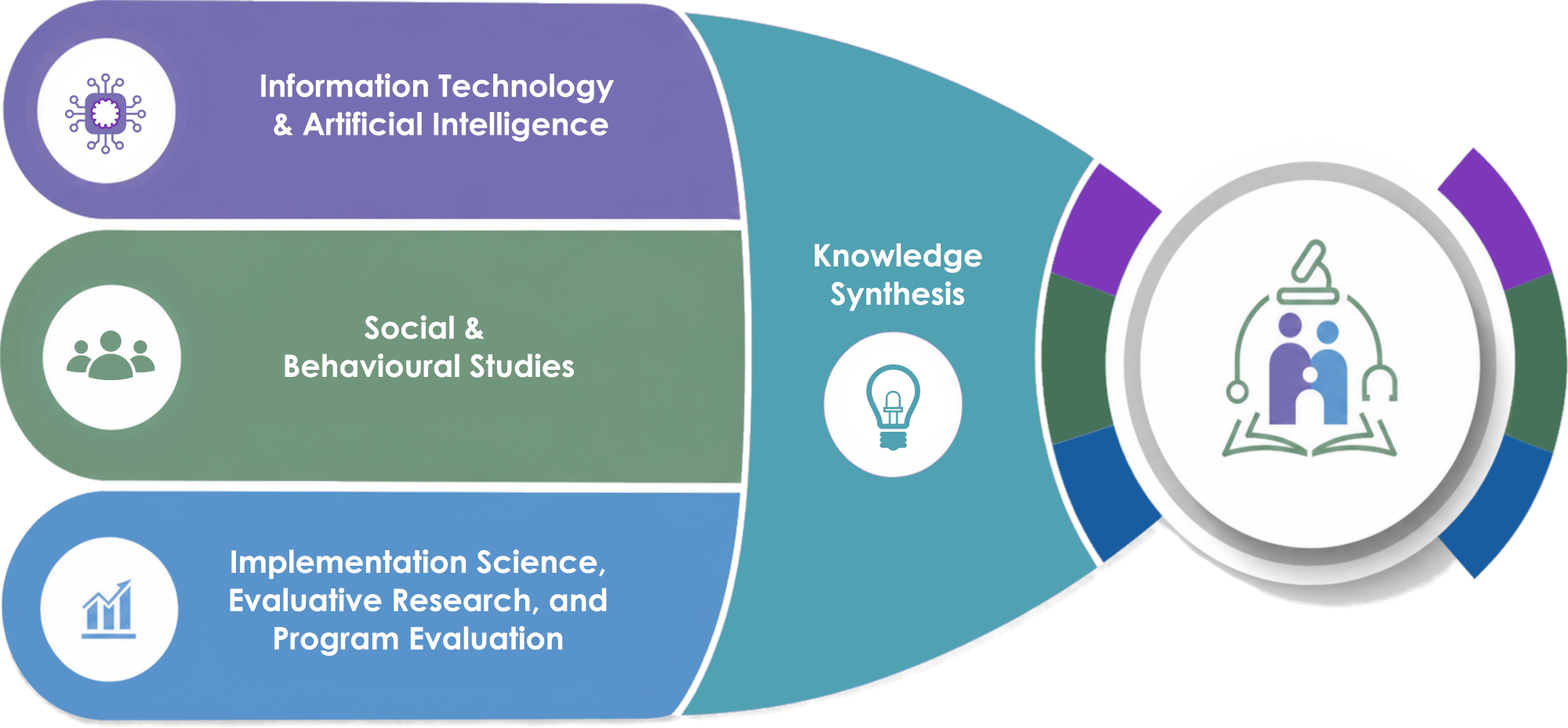
Information Technology and Artificial Intelligence
- This research area examines the development, use, and evaluation of information technologies and artificial intelligence in family medicine education.
- Research Area Leader: Dr. Roland Grad
Social and Behavioural Studies
- This research area investigates the social, behavioural, relational, and contextual dimensions of family medicine education.
- Research Area Leader: Dr. Pierre-Paul Tellier
Implementation Science, Evaluative Research, and Program Evaluation
- This research area focuses on the implementation, evaluation, and improvement of educational programmes, practices, and innovations within family medicine.
- Research Area Leader: Dr. Keith J. Todd
Knowledge Synthesis
- This research area brings together and critically examines existing evidence to support research, education, policy, and practice. As a transversal area of investigation, Knowledge Synthesis also contributes to and connects work across the other three research areas.
- Research Area Leader: Dr. Machelle Wilchesky




Are you interested in Family Medicine Education Research?
It is an exciting time in health sciences education, and more specifically family medicine education research. Visit the pages throughout our website to learn more about what FMER members do, and how you might join us and collaborate with us.

FMER's founding members (photo by Heidi Hollinger, June 2015)